
Security & Mobile Computing
Become an expert in defending information systems and building trustworthy mobile applications.
- Cybersecurity & cryptography
- Information systems protection
- Secure mobile applications
- Auditing & penetration testing
Three years after the integrated preparatory classes. Active teaching, real projects and a specialisation from semester 8, for the most sought-after careers in tech.
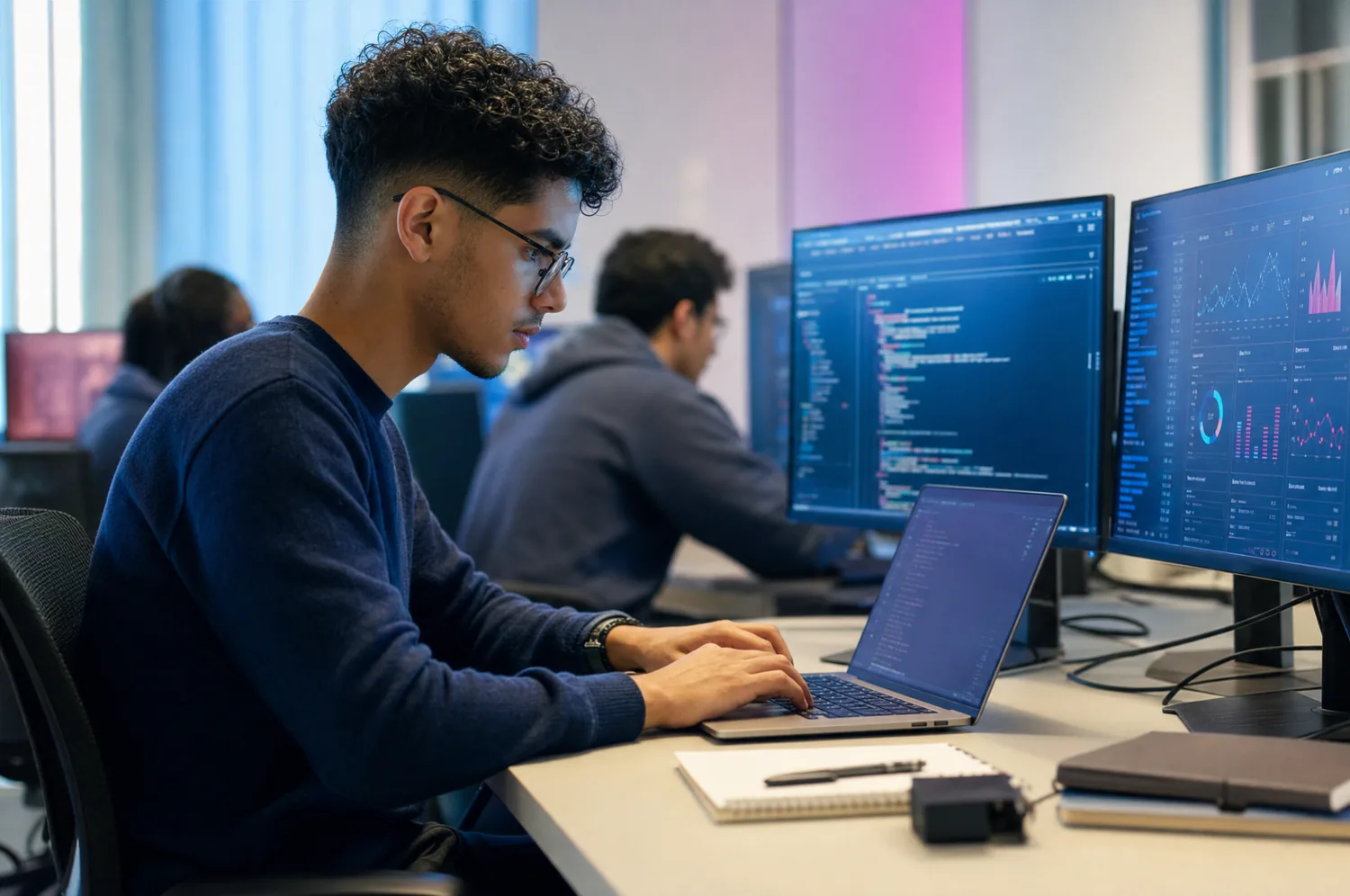
Computer engineering sits at the heart of every transformation: software and applications, data and artificial intelligence, cybersecurity, cloud and infrastructure. Our five-year engineering degree produces complete profiles, able to design, build, secure and industrialise the digital systems of tomorrow.
Project-based teaching, real lab work, industry frameworks and tools, specialisation from semester S8 and a final-year project in a company: you graduate ready to practise, with a state-recognised engineering degree that recruiters value.
A solid technical foundation, from software engineering to artificial intelligence, taking in systems, data, security and the cloud.
Object-oriented design, application architecture, design patterns, testing and code quality, agile methods.
Complexity, advanced structures, graph and optimisation algorithms, problem solving.
Relational modelling, advanced SQL, NoSQL, data warehousing and database administration.
Operating systems, systems programming, network protocols, administration and virtualisation.
Machine and deep learning, natural language processing, computer vision, model deployment.
Cryptography, application and network security, auditing, penetration testing and IS defence.
Cloud architecture (AWS · Azure · GCP), containers, CI/CD, infrastructure as code and observability.
Full-stack development, modern frameworks, native and cross-platform mobile applications.
From the shared curriculum to field expertise, each pair of semesters brings you closer to the State Engineering Degree and to employability.
Consolidating advanced computing skills and first systems integration work. Algorithms, data structures, object-oriented programming and databases are the core of the semester.
Preparing for specialisation and starting the option modules. Students refine their career plan and choose their track from semester 8 onwards.
Expertise in the chosen specialisation, professional immersion and a final-year project supervised by industry. The last step before the job.
A computing degree is not judged on its syllabus but on what happens in the room. Here is what a week at SUP2I really looks like.
Computer lab work: algorithms, data structures, back end, front end and databases. The lecture lays out the theory, the lab session puts it to the test.
A brief, a shared Git repository, peer code review and a demo in front of the year group. Exactly the loop a development team runs inside a company.
Network and systems labs, virtual machines, containers, cloud deployments and supervised penetration testing. You administer and secure real systems, never screenshots.
The Cisco CCNA, AWS, Microsoft Azure, Oracle and Huawei ICT Academy tracks are prepared during the course, alongside the degree itself.
Oral defences, written reports, technical English and professional communication. An engineer who cannot explain a solution never gets to deploy it.
Three cutting-edge options, aligned with real market demand. You choose your path in semester 8, then deepen it through to the final-year project.
Become an expert in defending information systems and building trustworthy mobile applications.
Design the models and data pipelines that transform businesses.
Architect the scalable infrastructure that runs the modern digital world.
Computer engineering opens the door to the most sought-after roles in tech, in Morocco and internationally.
Designing and industrialising robust applications.
Predictive models and turning data into value.
Defending and auditing critical systems.
Automation, CI/CD and platform reliability.
Distributed, scalable infrastructure.
Artificial intelligence solutions in production.
IT services firms, banks, telecoms, industry, software vendors, consulting and startups: our graduates join tech employers in Morocco and abroad.
Three ways to study computing at SUP2I, three durations, three exit levels. They are not aimed at the same profiles, and none of them is a consolation prize.
Still weighing up the two ways into a five-year degree? Read our comparison of integrated versus classic preparatory classes, or talk it through with us in a one-to-one guidance session.
Entry to Computer Engineering follows SUP2I’s integrated preparatory classes, or is granted on application for equivalent profiles. A fully digital application, with an answer within 48 hours.
Looking at a three-year degree first? Discover the IRM Bachelor’s degree (Computing, Networks & Multimedia).
Admission is based on your application, followed by a guidance interview and a written test for the engineering cycle. With a science or technical baccalaureate, you join the integrated preparatory classes: two years leading into the engineering cycle without a national entrance exam. With two years of science-based higher education (CPGE, DEUG, DUT, BTS), you apply for direct entry into the first year of the engineering cycle, with prior learning assessed against your own curriculum and specialisation. Applications are submitted online and answered within 48 hours.
Classic preparatory classes (CPGE) last two years and end with a national competitive exam that decides which school you join. SUP2I’s integrated preparatory classes cover the same scientific foundation, mathematics, physics, computing and engineering sciences, but you carry on in the same school: no exit exam, progress validated through continuous assessment, and contact with the computing programme from year one.
Yes. SUP2I is a private higher education institution recognised by the state and authorised by the Ministry of Higher Education. The engineering cycle awards a State Engineering Degree (five years of higher education), and the bachelor’s and master’s degrees are state-recognised too.
The IRM bachelor’s degree (Computing, Networks & Multimedia) leads to employment in three years, with an option in year three: development, artificial intelligence, or networks and cybersecurity. The engineering cycle takes five years from high school and works at a higher level of design and abstraction. The master’s degree is for those who already hold a bachelor’s and want targeted expertise in two years. All three routes are state-recognised.
You do not have to decide on day one. Semesters S5 to S7 are shared, and specialisation only starts in semester S8, once you have worked with all three fields in the lab: Artificial Intelligence & Data Science for modelling and data, Networks & Cloud Computing for infrastructure, Security & Mobile Computing for defending systems.
Yes. The final-year project runs across semesters S9 and S10, in a company (four to six months), with both academic and industrial supervision, followed by a written thesis and a defence before a panel.
The programme covers Java, Python, C/C++, JavaScript/TypeScript, SQL and NoSQL, as well as Git, Docker, Kubernetes, the AWS/Azure/GCP clouds and AI frameworks (TensorFlow, PyTorch). It also prepares students for the Cisco CCNA, AWS, Microsoft Azure, Oracle and Huawei ICT Academy certifications. The emphasis is on project-based teaching and real lab work.
A question about admission to Computer Engineering?
Cisco, Huawei, AWS, Oracle and Microsoft: students on the computing, networks and AI tracks prepare industry-recognised certifications as part of their degree.
 CCNA · CCNP
  ICT Academy
  AWS Academy
  Oracle Academy
  Imagine Academy
 Apply now, or come and meet us at the next Open Day. Your career starts here.