
Industrial Systems Automation
Design and run automated production lines: programmable logic controllers, SCADA supervision and industrial networks.
- Logic controllers (PLC)
- SCADA & supervision
- Industrial networks
Where mechanics, electronics and computing meet. Train in smart systems, robotics and Industry 4.0.
Mechatronics brings together four worlds (mechanics, electronics, control engineering and computing) to design the machines of tomorrow: robots, autonomous vehicles, connected objects and Industry 4.0 factories.
Over three years (S5 to S10), our future engineers move from a solid multidisciplinary foundation to a sharp specialisation, then to a six-month final-year project in a company. A programme built for employability, recognised by the state.
Looking at a three-year degree first? The same three options exist in the Mechatronics Engineering Bachelor’s degree.
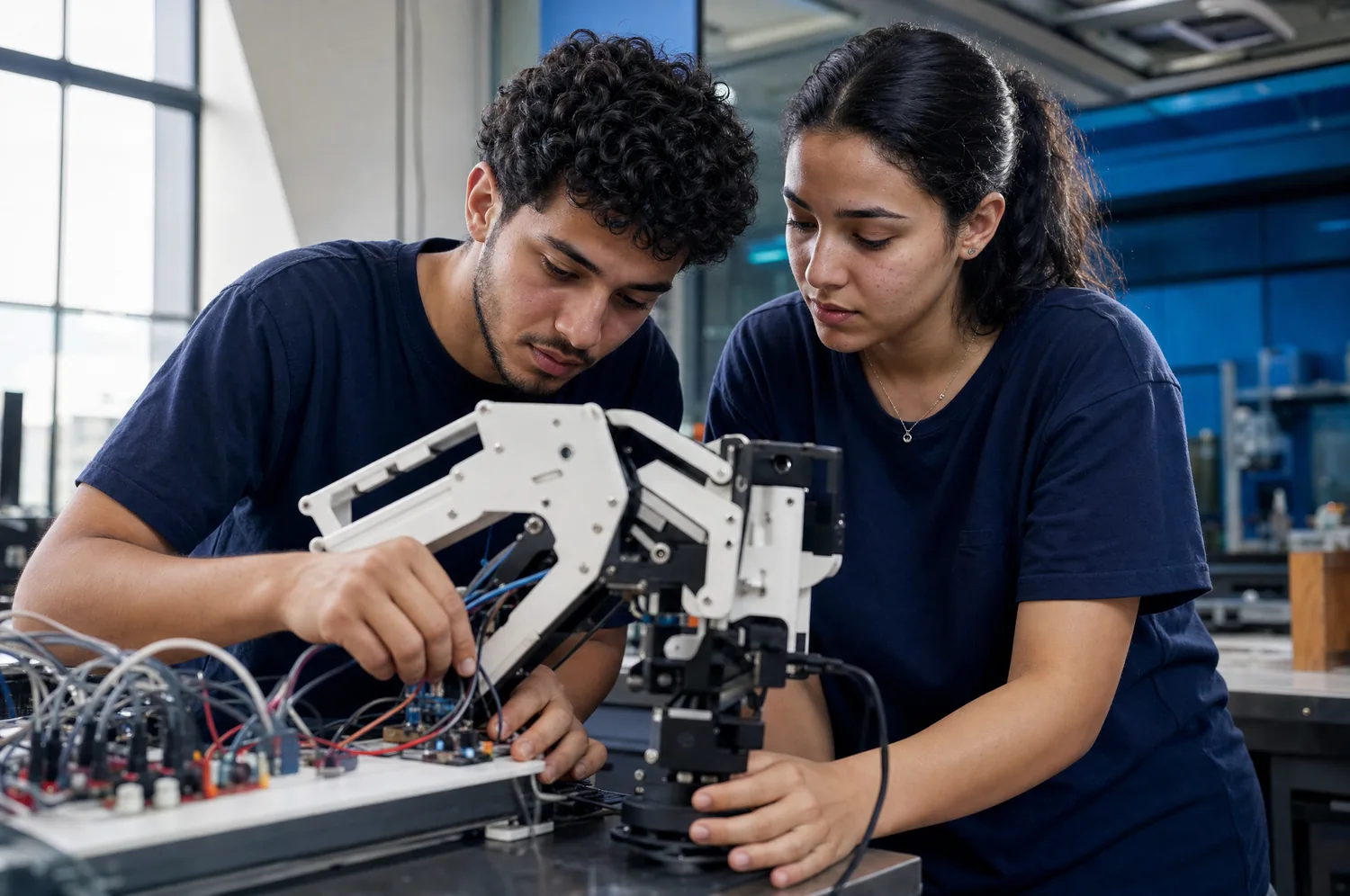
Mechatronics is the discipline that designs machines able to sense, decide and act. It brings together in a single object a mechanical part, control electronics, a piece of software and a control loop that ties them together. A robotic arm, a car’s ABS, a lift or a bottling line are all mechatronic systems.
A mechatronic system is not a machine with electronics bolted on: the four building blocks are designed together from the start.
Mechatronics is not a laboratory subject. It is already embedded in Moroccan industry, a few kilometres from the campus.
Across the three years you move from the drawing to the machine that runs, on the standard tools of industrial workshops.
Want the long version? Read our article on what mechatronics is, with examples and careers.
A mechatronics engineer masters the whole chain, from the sensor to the algorithm. These are the fields you will explore.
Microcontrollers, real-time programming, FPGA and electronic board design for smart products.
Modelling, servo control, regulation and control theory for complex dynamic systems.
Kinematics, perception, actuators and motion planning for mobile robots and manipulator arms.
Converters, motorisation, energy management and high-performance electric drives.
3D modelling, structural analysis, prototyping and mechanical integration of mechatronic systems.
Connected sensors, digital twins, supervision and smart production lines.
A structured progression: shared core, advanced study, specialisation from S8, then a six-month final-year project in a company (S9–S10).
Three expert tracks to steer your career towards the most in-demand roles in industry.
Design and run automated production lines: programmable logic controllers, SCADA supervision and industrial networks.
Optimise industrial performance: lean manufacturing, production methods and operations management.
Master mechanical design end to end: CAD, manufacturing processes and finite element simulation.
By the end of the programme you are a job-ready engineer, able to design and lead complex systems from end to end.
Humanism · Entrepreneurship · Professionalism, at the heart of every project.
Mechatronics sits at the heart of the industrial transition: automotive, aerospace, energy, robotics. Your skills are rare and sought after.
Design, integration and deployment of robotic systems in industry or R&D.
Firmware and electronics development for connected and safety-critical products.
Process automation, controller programming and industrial supervision.
Line optimisation, quality and the move from prototype to series production.
Product innovation, rapid prototyping and mechatronics technology watch.
Architecture of connected solutions, sensors and data serving the smart factory.
Entry after high school via the integrated preparatory classes, or parallel admission into the engineering cycle (two or three years of science-based higher education). Application, tests and interview.
Apply now, or come and meet us at the next Open Day. Your career starts here.